Eligibility for the upcoming election is tied to historic farmland ownership, and excludes large portions of the Valley. Far-right political groups are seizing on that.
As immigration took center stage, a Phoenix woman’s trip to the nation’s capital spotlighted her detained partner’s declining health and broader criticisms about LGBTQ+ safety in custody.
Turning Point Targets SRP Election Shaped by Unequal Voting
Eligibility for the upcoming election is tied to historic farmland ownership, and excludes large portions of the Valley. Far-right political groups are seizing on that.
Voting begins March 11, with all ballots due back by April 7.
Nearly half of the 1.1 million customers served by the state’s largest utility company are barred from voting in an upcoming election that has drawn support from Turning Point Action, using the race to remove what they claim to be “radical environmentalists” from utility leadership.
SRP users in large portions of the Valley’s more politically progressive areas in downtown centers — such as Phoenix, Mesa, Tempe, Chandler and Glendale — are not eligible to vote in the April 7 Salt River Project election, which will help determine the leadership in Arizona’s largest public utility.
At the same time, some property owners who are not SRP customers are eligible.
Unlike most elections, voting eligibility for the Salt River Project, or SRP, election is not tied to residency, but to a century-old land ownership agreement connected to historic agricultural parcels.
It also deviates from standard elections, as eligible voters must request a ballot individually (being on the state’s early voter list does not qualify someone to receive a ballot), and residents can only vote if they are property owners. Voting rights groups, meanwhile, have raised questions about equity and who has a say in their public utilities.
Advocates and candidates say those rules — combined with typically low turnout — make the election unusually consequential despite its low public profile.
Who’s backing whom?
Both the water and power divisions of SRP are governed by a board and a council, which set utility rates and internal policies, respectively. This year’s election includes races for board president and vice president, seven board seats and 15 council seats.
Turning Point Action — the lobbying and political arm of the far-right Christian-conservative group Turning Point USA — has endorsed nine candidates, including those under the Elected Leadership for SRP banner. Those include Christopher J. Dobson for board president and Barry E. Paceley for vice president, and Kelly Cooper and Rusty Kennedy for at-large board seats. Other endorsed candidates include Nina Mullins, Mark V. Pace, Paul Rovey, Nicholas J. Vanderwey and Leslie C. Williams.
They face opposition from a slate of candidates called the SRP Clean Energy Team, which includes former Arizona Corporation Commissioner Sandra Kennedy for president and current at-large board member Casey Clowes for vice president, along with Nicole Brown, Lupe Conchas, Allison Gullick, Regina Gutierrez, Melissa Harlan, Kathy Mohr-Almeida, Randy Miller and Krista O’Brien. The team has also endorsed Ken Clark and John and Sara Travise.
Although SRP elections are officially nonpartisan, those running describe the contest as carrying broader political implications related to energy policy and governance. And online, the race has drawn attention from Arizona’s far-right political faction.
Far-right former state senator from Tucson Justine Wadsack posted on social media with Turning Point Action members saying that the SRP election was a test to get Congressman Andy Biggs, a MAGA conservative, elected to governor.
And Turning Point Action Chief Operating Officer Tyler Bowyer wrote on social media that his goal in the race was to significantly increase Trump-aligned conservative voter participation in the election, arguing that the outcome could influence Arizona’s energy direction.
“My goal is to out-register the Democrats 10-1 for the (SRP) election,” he wrote on his social media profile on X. “We need to get the radical environmentalists out of AZ and prevent them from dramatically increasing our utility rates.”
It is unclear how much money Turning Point Action has put into the race: Josie Mitz, a spokesperson for the Clean Energy Team, told Axios that they expect to be outspent 10 to 1. The public information officer for the Maricopa County Recorder’s Office, which tracks campaign finance spending, didn’t return a series of emails LOOKOUT sent over several weeks. And no campaign finance reports have been released publicly, yet.
Clean-energy advocates said Turning Point Action is attempting to take advantage of a voting system that shuts out areas populated by largely progressive, younger voters, as well as renters.
Turning Point did not respond to emails for comment.
Unequal voting rights
SRP elections operate under a system created more than a century ago, when the Phoenix area consisted largely of farms and small settlements.
Today, SRP functions as two interconnected entities: the Salt River Valley Water Users’ Association, a private corporation formed in 1903, and the Salt River Project Agricultural Improvement and Power District, a political subdivision of the state established in 1937. Neither entity is regulated by the Arizona Corporation Commission.
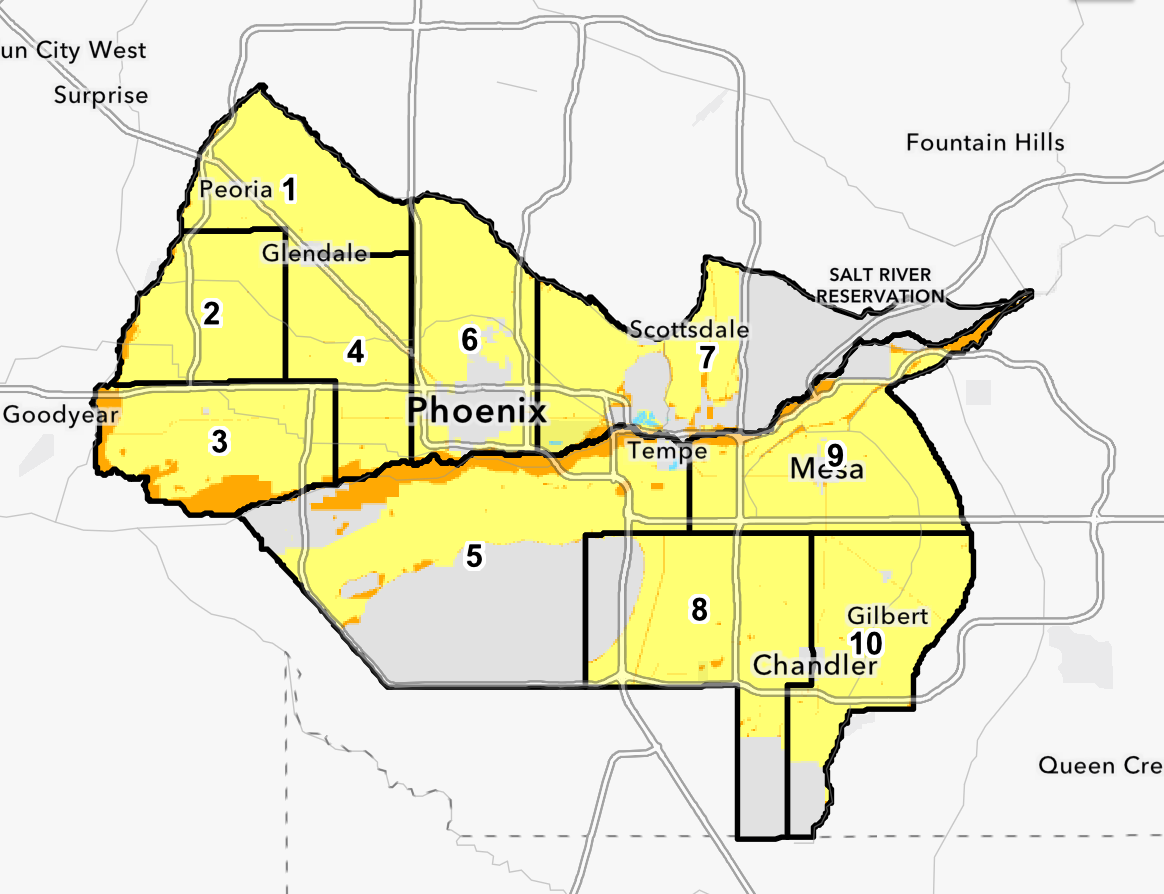
A screenshot of the SRP voter map. Marked out grey spaces within the black outlines are areas ineligible for voting in the April 7 election. Credit: SRP
Voting rights stem from early agreements in which farmers pledged land as collateral for federal infrastructure loans used to build canals and the Roosevelt Dam. Those landowners received voting power proportional to their acreage — a system that remains in place even as farmland has been subdivided into suburban neighborhoods.
Under the system, voting strength corresponds to land ownership. Owners of large properties may cast hundreds of votes, while a homeowner on a quarter-acre lot receives one-quarter of a vote, divided among co-owners if applicable.
For example, someone who owns a 300-acres gets 300 votes, whereas the owner of a single-family home on a quarter-acre lot gets one-quarter of a vote. If two people own that home, that vote is split.
The exception is four at-large seats — two of which are being voted on this April — in which every voter is counted as one whole vote.
But only eligible landowners who actively request a ballot receive one, and SRP elections — held every two years — typically see turnout of about 5%.
“When I talk to people about it and tell them what’s going on, they get pretty irate that nobody told them about their (rights),” said Ken Clark, who is running for the board. “Power likes to maintain power. If you’re part of this … multigenerational group of people who have been able to dominate the board based on the fact that you own more land, why would you want other people to participate in that election?”
Because many downtown neighborhoods throughout the Valley were not developed from those original agricultural parcels, residents there are often excluded from voting eligibility. Suburban communities built on converted farmland are more likely to qualify.
But that isn’t always the case: In Phoenix’s Ahwatukee Foothills — which wasn’t developed until decades after the agreement with landowners was inked — or outlying areas such as Fountain Hills and Queen Creek, only a small portion of residents are eligible to vote in the April 7 election.
SRP did not respond to emails for comment.
Who is left out
A review by LOOKOUT found that many of the areas ineligible to vote in the upcoming election include precincts that heavily favored former Vice President Kamala Harris in the 2024 general election. In Phoenix, the Edison, McDowell, Lowell, and Westward Ho districts are ineligible to vote; each of those precincts supported Democrats by more than 70%.
Parts of Glendale’s Tuckey, Myrtle, and Imes districts are also excluded from voting, and those areas likewise voted for Harris. In Chandler, parts of the Commonwealth, Danyell, and Carla Vista districts — where Harris received roughly 55% to 60% of the vote — are also ineligible.
To be sure, some Republican-leaning areas are also excluded. The entirety of suburban Fountain Hills, where Donald Trump received nearly twice as many votes as Harris, is also unable to participate in the election.
Still, the map of ineligible areas — shaped largely by patterns of urban development — means that many urban centers, where progressive voters are more concentrated, have been left out of the election.
Several candidates and advocates interviewed said SRP’s governance structure reflects historical conditions that no longer align with the region’s current demographics, which have grown rapidly and become far more diverse over the past decade.
Advocates note that homeownership disparities may also affect participation rates. A report from the Urban Institute, for example, found LGBTQ+ adults are less likely to own homes than straight and cisgender adults, potentially narrowing the eligible electorate further.
Nick Arnold, political committee chair for the Sierra Club Grand Canyon Chapter, said the limited electorate makes turnout especially influential. As an openly gay man, he said he was worried about how the politics of Turning Point could influence conversations about utilities.
“This is an election where relatively small numbers of voters can shape decisions affecting a large population,” Arnold said. “This board can play a major role in bringing costs down, and it’s, at a very bare minimum level, unproductive to have the politics of MAGA involved in a conversation about, ‘How can we run a productive and affordable grid in Arizona?’”
An earlier version of this article said Nick Arnold worked for Climate Cabinet. He no longer works for the organization, and this article has been updated to reflect his current position.
Before you go...
At LOOKOUT, we believe in the power of
community-supported journalism. You're at the heart of that community, and your support helps us deliver the
news and information the LGBTQ+ community needs to thrive.
LOOKOUT Publications (EIN: 92-3129757) is a federally recognized nonprofit news outlet.
All mailed inquiries can be sent to 221 E. Indianola Ave, Phoenix, AZ 85012.