Every month, the same five voters in five states answered the same questions about candidates, violence and the fairness of the vote. Here's what they said.
The ballot description, and official analysis for Arizona's anti-transgender sports and private-spaces measure all left out naming who the measure effects. The state said that kept the language legally sound.
What 5 Independents in the Southwest Told Us From July to November
Every month, the same five voters in five states answered the same questions about candidates, violence and the fairness of the vote. Here's what they said.
In the months leading up to the November election, LOOKOUT spoke to five independent voters across five states in the Southwest. Every month, they answered the same questions, gauging their opinions on candidates, policy platforms, political violence, election interference and the well-being of the country.
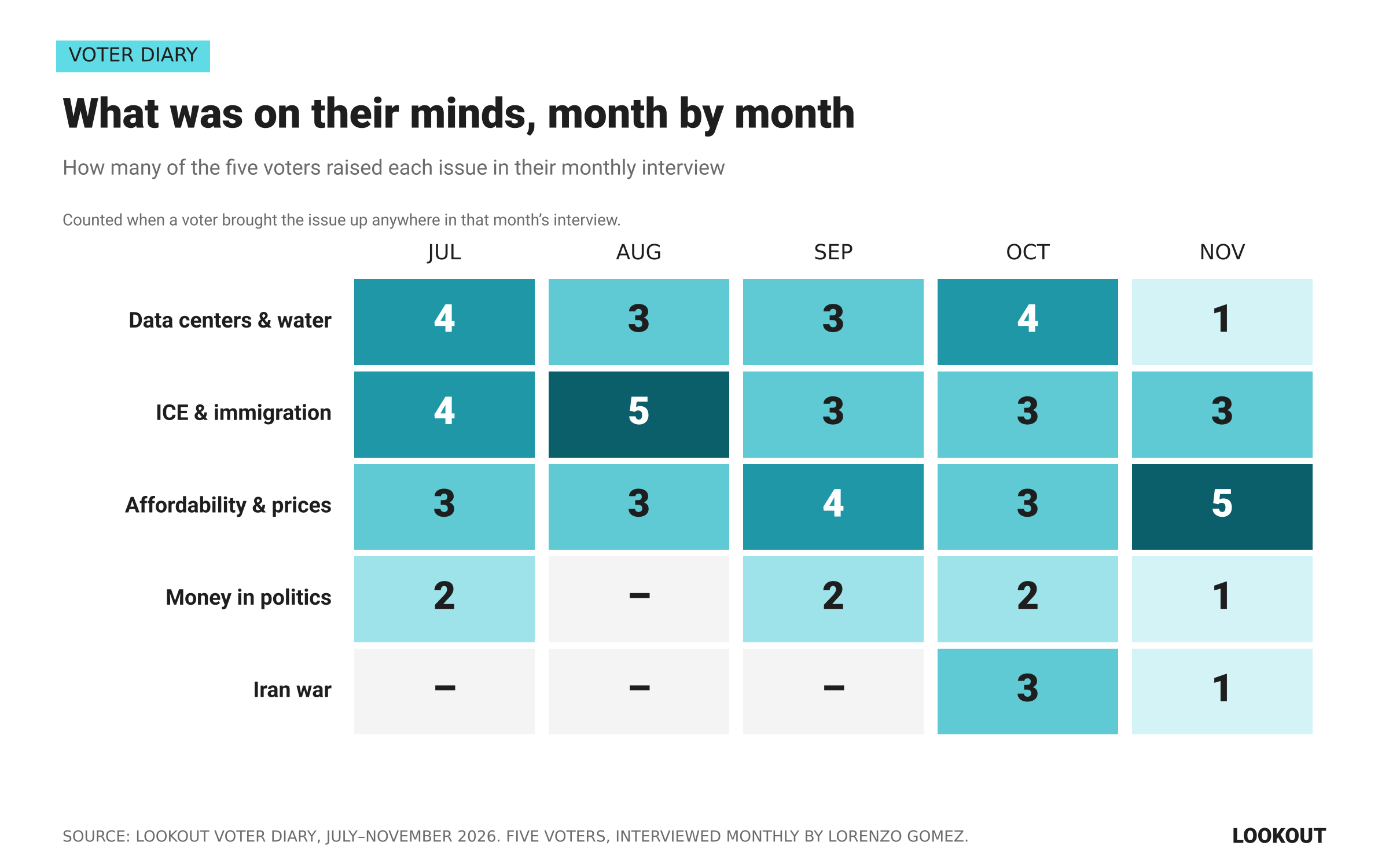
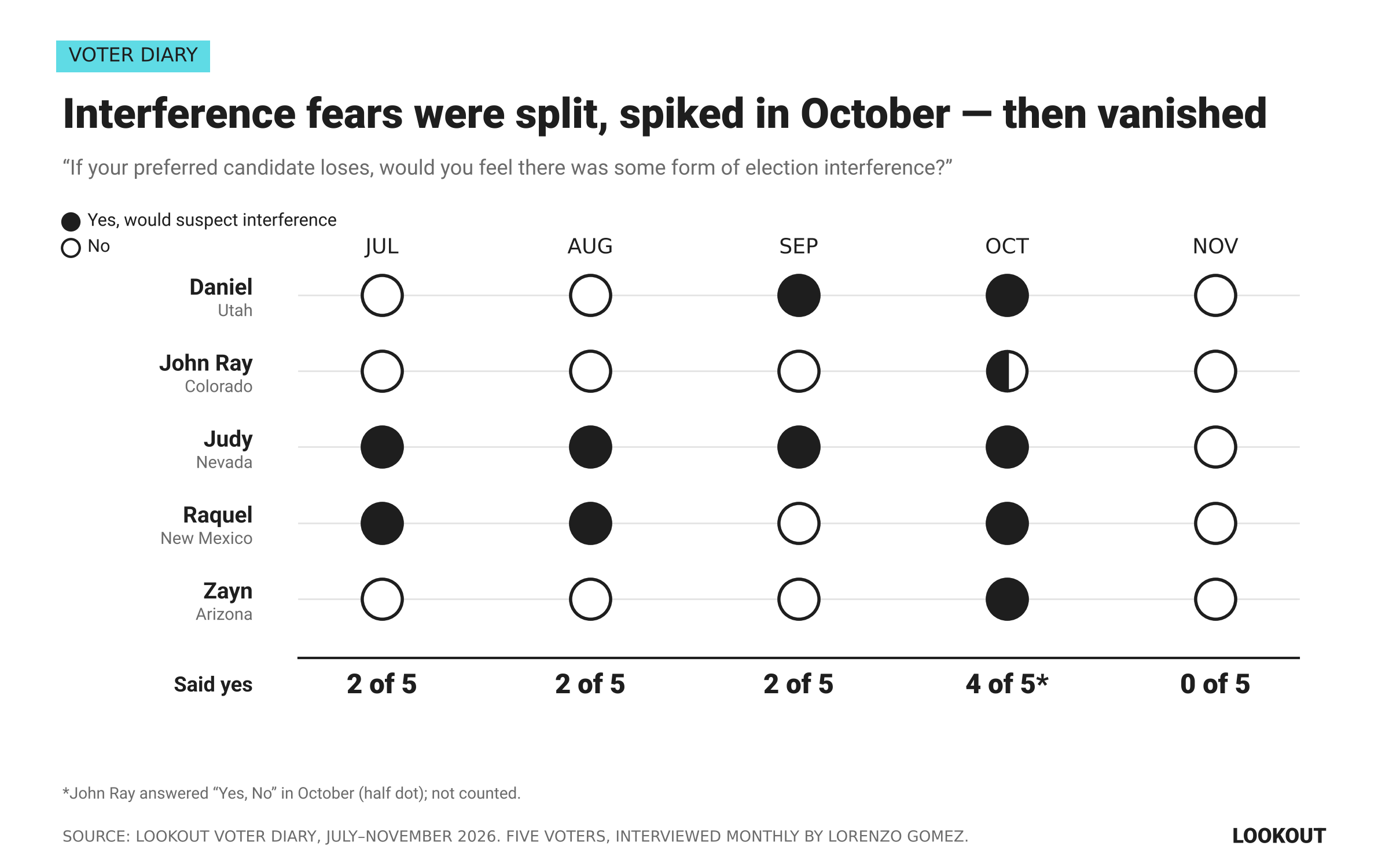
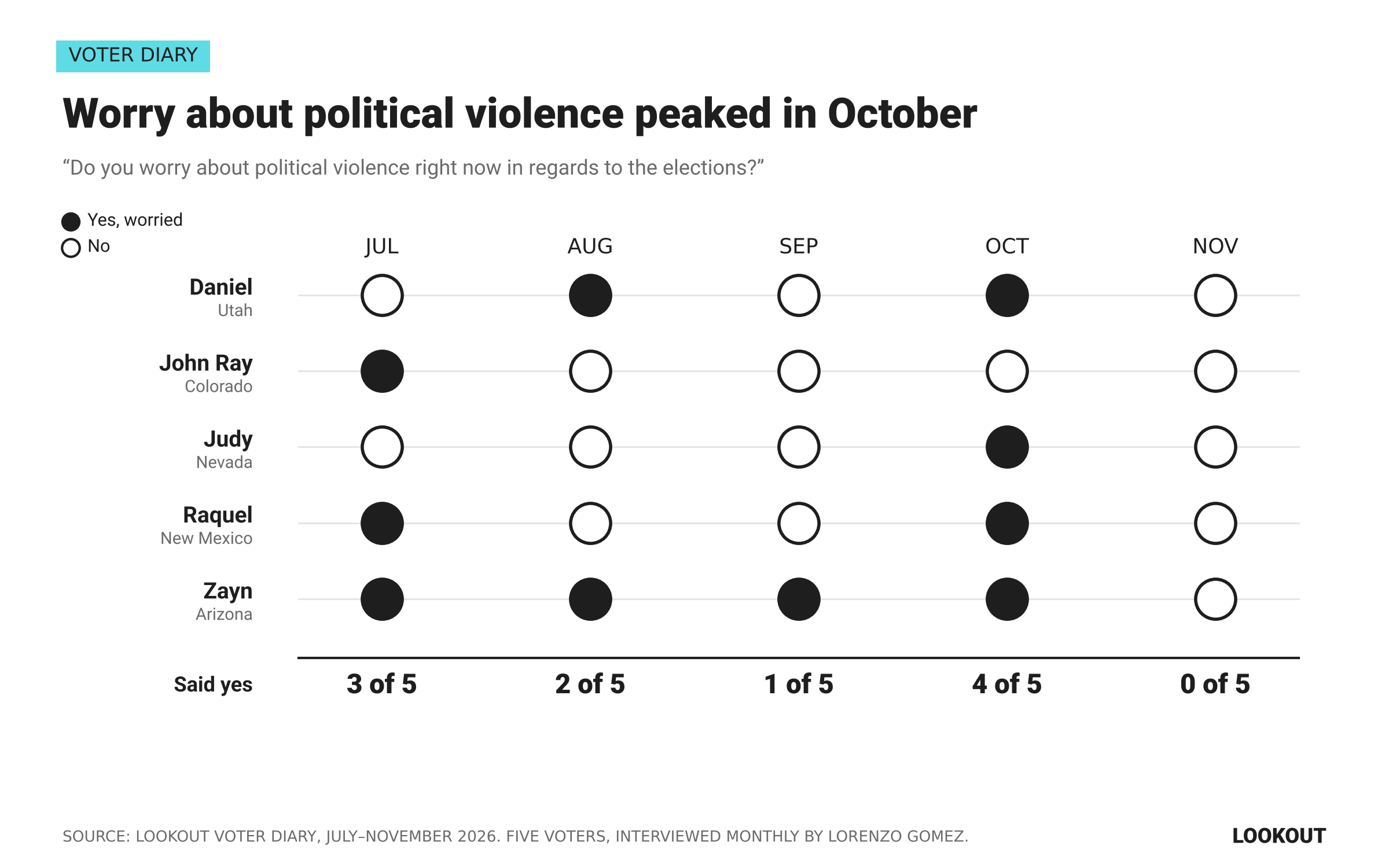
For the final installment of this voter diary series, we charted their responses and broke them down into five issues that resurfaced throughout our conversations: Election interference, political violence, data centers, immigration enforcement and affordability.
At least three of the five voters raised data centers or water every month from July through October, before the issue faded after the election. Immigration enforcement peaked in August, when all five brought up ICE. Affordability came up every month, and by November all five were talking about it.
Their trust in the election itself swung harder. Through September, two of the five said they would suspect interference if their candidate lost. In October, four said so. After the election, none did.
Worry about political violence followed a similar curve. Three voters were worried in July and four in October, though most pictured it happening in a big city or another state rather than close to home. In November, all five said they were not worried.
Use the map below to see where each voter stood on these issues month by month, and what they told us.
Over time, independent voters swung, then came together
From July through the week after the November midterms, LOOKOUT checked in once a month with the same five independent voters across the Southwest. Pick a topic, then step through the months to watch their answers change. Click any voter’s name to read what they said on that topic every month.
Notes are paraphrased from monthly interview notes; words in quotation marks are the voter’s own. For data centers, immigration and affordability, a voter counts as raising the issue if it came up anywhere in that month’s interview.
In October, John Ray answered the interference question “Yes, No” and is shown as half-filled; he is not counted as a yes. November interviews took place after the Nov. 3 election.
This interactive was built by using Claude for coding purposes. Editing and layout was done by LOOKOUT staff. Illustrations were designed by creators at Penji, and other art through Adobe Stock.
SOURCE: LOOKOUT voter diary, July–November 2026.
Judy Smith, a progressive voter from Nevada, initially felt deeply pessimistic and hopeless about the political landscape, rating her confidence in her preferred candidates as a 2 out of 5 and predicting the nation's situation would only grow worse.
However, after the Democratic wins in Nevada, including Aaron Ford’s victory in the governor’s race, her perspective shifted to a slightly more neutral outlook, though she remained highly realistic and suspicious that things would ultimately stagnate or worsen once controversial legislation like Trump’s “Big Beautiful Bill” takes effect in 2027.
At first, Zayn Gordon, a left-leaning voter, felt relatively optimistic about the nation's future and expressed strong confidence in local election security, though he harbored deep concerns regarding ICE facilities and environmental issues like desert data centers.
Over time, his anxiety grew due to rising economic pressures and potential voter intimidation, but he ultimately felt relieved and positive following sweeping Democratic victories in Arizona, saying he was excited to see what happens in January.
In July, Raquel Johnson felt highly confident in New Mexico's progressive direction but uneasy about election fairness. She also harbored deep concerns about environmental issues like data centers and the federal government's support of Israel.
Over time, her anxiety and skepticism grew as she watched her preferred candidate, Deb Haaland, accept campaign money from corporate and lobbying interests, but she ultimately felt relieved and optimistic after a successful election; however, her concern about Immigration and Customs Enforcement in the predominantly Latino state remains strong.
Initially, conservative Coloradan John Ray Hairston was highly skeptical of Republican gubernatorial candidate Victor Marx's chances, rating his confidence in a victory at only a one out of five because of the state's strong left-leaning tendencies. However, as the election drew closer, his confidence rose to a three out of five as he noticed more people around him paying attention to the race, although he ultimately lost.
About halfway through, Hairston joined the other four voters in his concerns regarding the rise of data centers in Colorado, calling it one of the few issues Republicans and Democrats agree on. Additionally, he voiced frustration with the hyperpartisan nature of modern politics, comparing people's devotion to their political parties to a religion and lamenting the loss of open dialogue and common sense.
In Utah, progressive labor organizer Daniel Martinez never strayed away from his concern for working-class issues.
Over the course of our conversations, his focus on policy issues shifted from a broad critique of the Democratic Party's neglect of the working class to a highly specific dread regarding the future of social safety nets. While he initially prioritized local labor unionization and environmental crises like the Great Salt Lake, his anxiety ultimately intensified around a perceived bipartisan threat to cut Social Security and Medicaid
Martinez ended with a neutral outlook on the country’s future, despite the historic number of wins for Democrats. He worries that the blue wave will lead Democrats to take things “back to the way it used to be.” But Martinez said fixing the country will require transformational change for working-class people.
Ultimately, most of these voters felt affordability brought home the win for Democrats. Their deeper feelings and outlook go beyond gas prices and groceries. They stem from disappointment in government, which they feel has been unresponsive to constituents' needs. Even while some spent the night of Nov. 3 celebrating, Johnson and Martinez said that celebration should be followed by accountability.
Before you go...
At LOOKOUT, we believe in the power of
community-supported journalism. You're at the heart of that community, and your support helps us deliver the
news and information the LGBTQ+ community needs to thrive.
The ballot description, and official analysis for Arizona's anti-transgender sports and private-spaces measure all left out naming who the measure effects. The state said that kept the language legally sound.
AZ Blue sent coverage-cut notices during open enrollment for medications covering HIV treatment as well as prevention. After LOOKOUT probed deeper, the insurer decided to back off on their decision.
In this bonus episode of 'Hate State,' executive producers and hosts Ann Marie Awad and Xandra McMahon talk on the results of the election, and what comes next for trans civil rights in the state.
Voters who gave Democrats control of Arizona’s Legislature for the first time in 60 years told LOOKOUT they want real change. Democratic leaders are promising to be “thoughtful and intentional.”
LOOKOUT Publications (EIN: 92-3129757) is a federally recognized nonprofit news outlet.
All mailed inquiries can be sent to 221 E. Indianola Ave, Phoenix, AZ 85012.