NEWS
LOOKOUT Named “Best Protection Against Fascism” in Phoenix New Times’ Best of Phoenix 2026
LGBTQ+ nonprofit newsroom honored for accountability journalism and community-building.


In southern Arizona, a predominantly queer and femme protest camp is risking arrest to protect a cottonwood and stop a $500 million border wall project.

Early on the morning of Aug. 10, a crew of activists drank coffee under a series of shade tents and tarps in the tiny Arizona border town of Lochiel. It had stormed overnight, and the tall grass and scattered tents were wet and sparkling in the morning sun. Heavy monsoons had the surrounding valley bursting with green. A horse, silhouetted against the cream of a dawn sky, grazed on a nearby rolling hill across the border in Mexico, and a partially built double border wall rose over the eastern horizon like two shark fins.
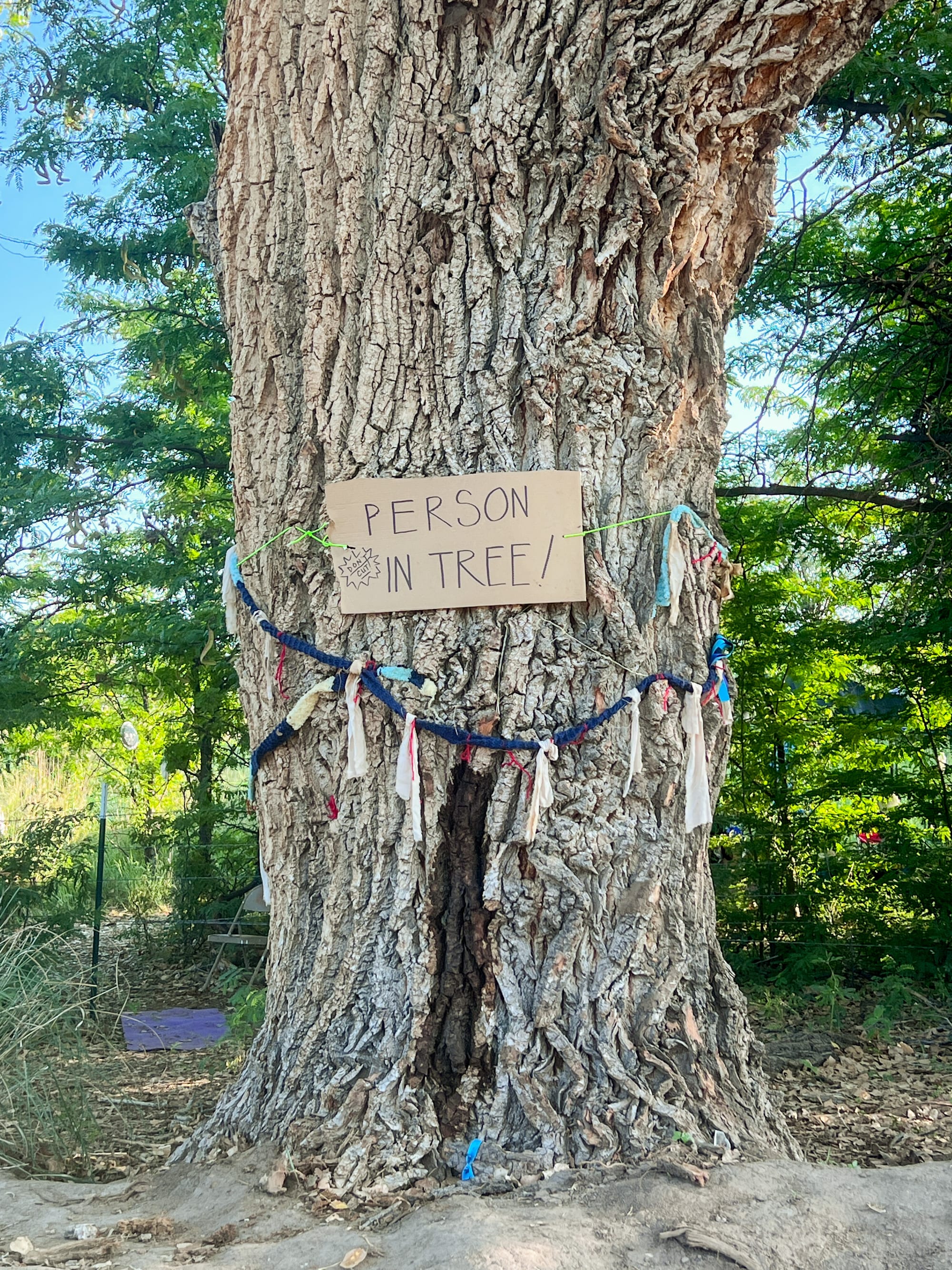
More than 50 feet above the activists drinking coffee under the shade tents, a person perched on a wooden platform in a giant cottonwood tree leisurely dangled a leg. They had spent the night in the tree, as they had for the previous 12 nights.
Storms can be dangerous for anyone teetering among the branches of the cottonwood, as can a nest of bees. And cottonwoods are known to be perilous for climbers or people camping underneath them because of their propensity to drop limbs. But over coffee in the camp kitchen, which also functions as a gathering space and support center, people who have been up in the tree say they find peace in the canopy. Their deep connection to the land, their long commitment to immigrant rights and their fight against various forms of state violence have convinced them the perils are worth it. The real danger, they say, is the project they are bent on halting.

Neither the person currently in the tree nor multiple members of their support crew below would share their names for fear of criminal charges or vigilante attacks, especially as the Trump administration has begun prosecuting people like the activists under a federal directive that could charge them as domestic terrorists. One person has already been arrested for blocking construction crews in late July.
LOOKOUT spoke with five people on the ground, some of whom have spent time in the tree stand. We camped overnight with the activists to understand what they were fighting for, what’s at stake for them, and how they think the standoff will end.
“Border wall construction was seen as an impossible thing to stop,” said the activist who was perched in the tree during our visit. “And yet, here we are, and people are stopping it.”
That person — who is being supplied with water and food by a system of pulleyed buckets and protected from the elements by a sleeping bag and tarp — is currently holding off the completion of a $500 million border wall construction project. They, along with a dedicated support crew of anti-border activists, are now more than two weeks into a tree sit and political encampment in Lochiel, a tiny town about 25 miles east of Nogales.
The border wall construction project in the San Rafael Valley, southeast of Tucson, Arizona, is a planned 27-mile span of double wall along the Arizona border. The wall is 30 feet high and runs parallel to another wall, with an approximately 60-foot no-man’s-land buffer zone between them. Miles of the double wall have already been built.
The price of the two barriers for the 27 miles is divided between two contracts, both for Fisher Sand & Gravel, and is estimated to cost around $500 million. The contract for the first span of the 27-mile-long wall was for $309 million. The second, parallel wall of the same length is part of a multi-project contract in Arizona worth about $1.5 billion. Some of the newly erected panels have already started to warp and lean.
While work is ongoing — earthmovers and diggers clanking, shoveling and belching exhaust during the day and sometimes at night — the completion of this span of wall is currently being thwarted by the tree sitter.
LOOKOUT relies on tips from readers to get our news out. Click on the button below to submit a secure email to our team. Any information you send will be kept confidential in accordance with our ethics guidelines.
Email a TipKate Scott, one of the key organizers on the ground in Lochiel, said that despite the constant leering, clamoring construction, horn honking, and general unpleasantness of the local construction crews, “a peace permeates this land.”
She and others refer to the cottonwood trees as “grandmothers” after what she described as an “Indigenous women youth-led solstice ceremony” that took place in Lochiel in late June. Scott, who is a co-founder of the Madrean Archipelago Wildlife Center, was one of the first activists to try to protect the cottonwoods as part of a broader effort to stop border wall construction.
“The bees, the monarch butterflies, the wild oregano,” Scott said, listing the species she and others have marveled at and taken comfort in. “And all the while the grandmothers are guiding us.”
Scott reflected on how it was a “great loss” to watch the hundreds-year-old cottonwoods get destroyed.
She’d spent much of the summer camping out near or directly underneath the cottonwood. This moment, she said, felt like a tipping point.
“I think people will be emboldened by our actions.”
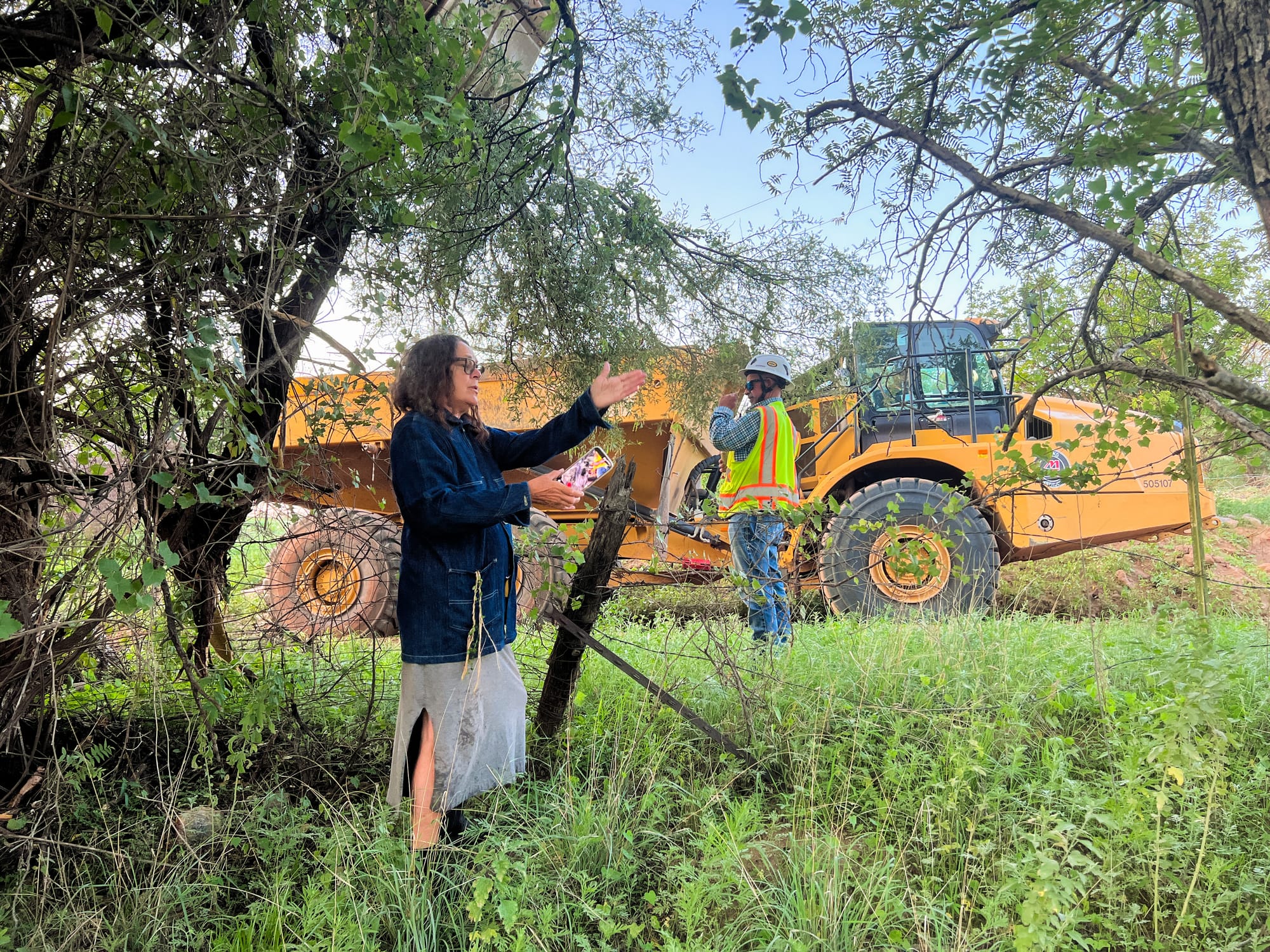
About a half-hour earlier, just after 5 a.m., Scott stood down yet another attempt to widen the road for more construction.
A crew with an excavator started knocking down the branches of another nearby tree, and Scott, phone in hand filming the encounter, approached one of the workers on foot. She told him he was breaking the branches of a tree on private property. After a few minutes of back-and-forth, even as the construction crew loaded one large broken branch into a giant dump truck, they moved on to another section of the wall.
“We are rooted and resolute,” Scott said afterward. Reflecting on the moment from a camping chair under the tree, she added, “I feel that there are fists coming up all over the country.”
 John Washington (he/him)
The predominantly queer and femme activists on the ground and in the tree have been staging events, protests, gatherings and ceremonies in the San Rafael Valley for months. The situation escalated in late July when three of the giant cottonwoods — which probably sprouted long before the border between the United States and Mexico was first drawn — were knocked down by an excavator. The arborcide encapsulated a broader political showdown and invigorated an already committed crew rallying against the wall.
Dozens of laws were waived to allow the construction to proceed. Dinah Bear, a Tucson-based environmental attorney and former general counsel for the Council on Environmental Quality, told LOOKOUT that not only have many environmental laws been waived to allow wall construction to proceed, but many procurement and contracting laws were also waived to grant the permits and contracts.
“Sadly, it is not surprising, but it remains shocking that in the name of law and order, the administration has waived 66 federal laws and purportedly all related state and local laws intended to protect Native American gravesites, the environment, wildlife, historic and paleontological resources and basic administrative laws to build double wall in the San Rafael Valley,” Bear said. “In addition, 24 laws and 10 sets of regulations governing the contracting process have been waived as well.”
All of it is happening in the context of an unprecedented and increasingly deadly anti-immigrant crackdown taking place throughout the country.
Much of the attention in Lochiel has now focused on the one remaining cottonwood still standing in the way of the proposed wall. Despite the focus on the trees, however, Scott and others say this is far more than just an environmental fight to protect a single tree.
One activist who has spent time in the tree told LOOKOUT that the wall embodied “toxic nationalism and authoritarianism,” and that protesting can show people another way forward.
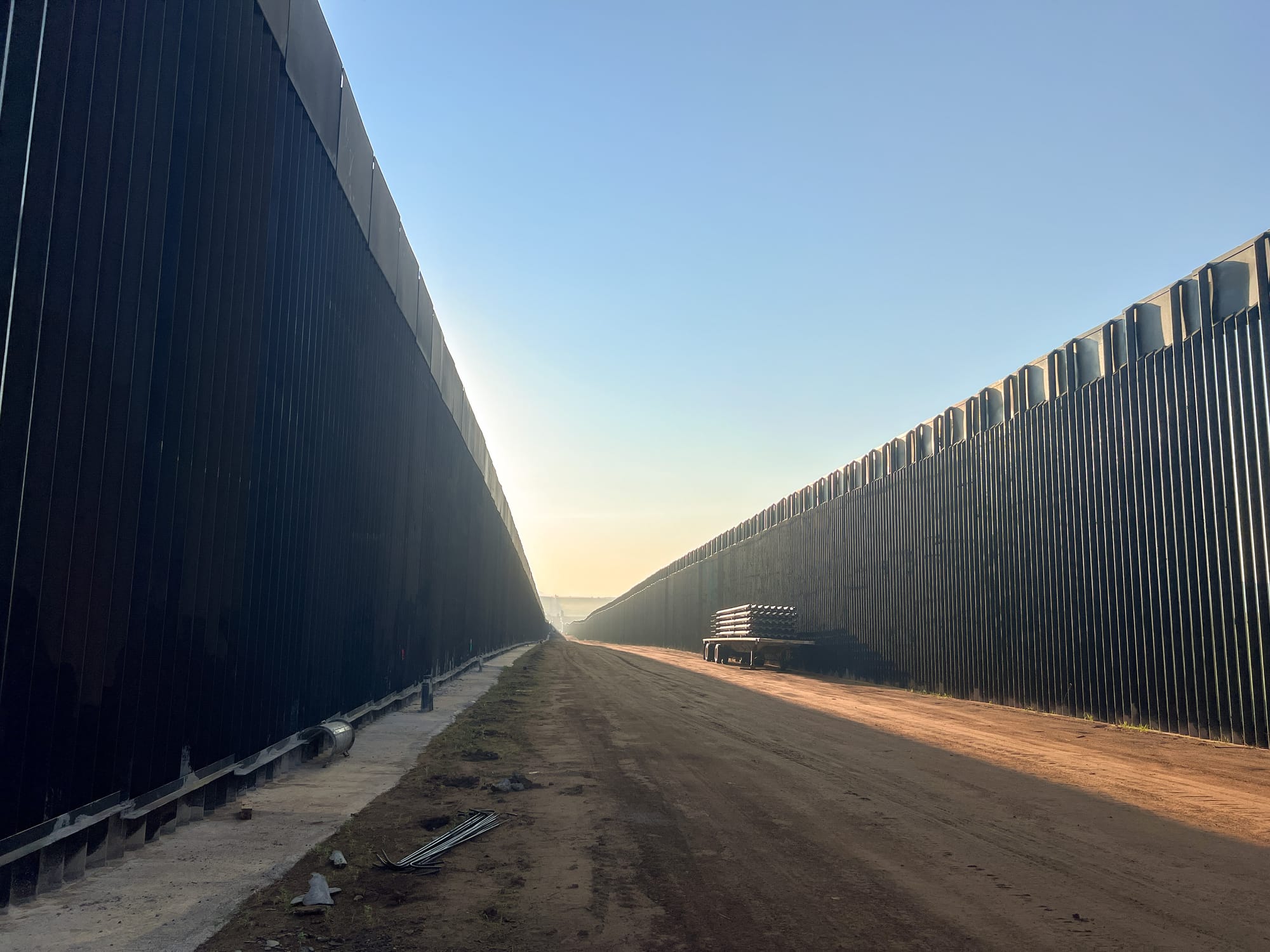
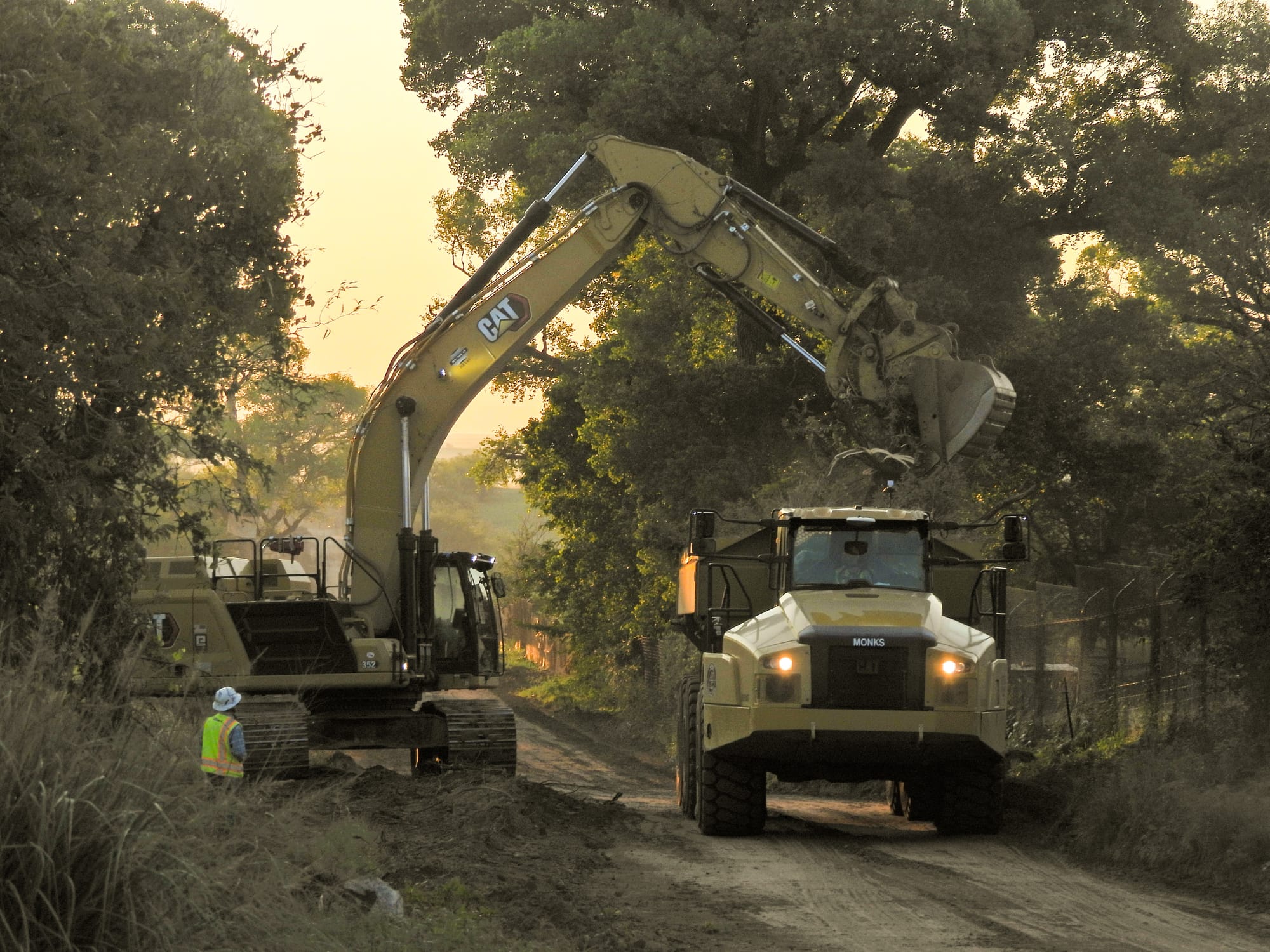
(Left) The dead zone between the two 30-foot high walls near Lochiel, Arizona. (Right) Construction crews haul away large branches from a tree. (Photos by John Washington)
Another person who has spent time in the tree explained the stakes: One person has already been arrested for blocking construction crews in late July. The activists haven’t been deterred, with one of them saying they saw the wall as “a tool of murder.” In the government's own view, the wall was a means of using death as a deterrent for border crossings.
In the 1990s, as some of the early stretches of wall were built along the U.S.-Mexico border, the strategy known as Prevention Through Deterrence deliberately funneled migrants into more dangerous and deadly crossing corridors, resulting in a spike in migrant deaths.
Due to how remote it is and the lack of robust highways just south of the valley in Mexico, very few migrants have ever crossed in the San Rafael Valley, according to studies conducted by Sky Island Alliance and other environmental groups opposed to wall construction.
Much more than a site of human migration, the valley is home to roaming antelope, jaguars, coatimundi, javelina, bears and other species. But those animals’ crossing corridors are being severed by the double wall.
“All of it has pushed ordinary people to take extraordinary measures to put their lives on the line to protect a tree that has become a symbol of the future we want, and the future we are ready to fight for,” said Erick Meza, Borderlands coordinator of the Sierra Club’s Grand Canyon Chapter. Meza has been another key organizer in the Lochiel standoff.
So while the activists in Lochiel hope to permanently block further construction and save the remaining cottonwood tree on the U.S. side of the line, they also recognize their fight is symbolic.
“I hope people will be inspired,” one activist said. “There are always ways people can slow or stop construction. And as soon as more people start resisting, it feels less and less impossible.”
It’s not the only standoff at the border. The Tohono O’odham Nation recently issued a no-trespassing order for any nontribal member on its nation, as part of an effort to block a border wall being built on its tribal land. In Texas’ Big Bend, activists are pushing back against proposed wall construction there.
The Lochiel camp sits about 10 miles from where, in 2022, former Arizona Gov. Doug Ducey built a border wall of shipping containers. Some members of the current tree protest said they were also part of the encampment that slowed and ultimately shut down that project.
A federal lawsuit later resulted in the shipping containers being removed. The stunt cost Arizona taxpayers $200 million. It was the first international barrier to go down since the fall of the Berlin Wall and has served as partial inspiration for the tree sit.
Multiple activists in Lochiel spoke about other legacies of resistance they’ve been leaning into as inspiration. They mentioned the forest defenders in Atlanta organizing around the Stop Cop City movement and the protest in Appalachia against the Mountain Valley Pipeline.
Taking a sip from a steaming coffee mug, an activist said, “The more they repress a community of resistance, the more people will get mobilized, pushing back even harder.”
 Jack Fernandez (he/him)
At LOOKOUT, we believe in the power of community-supported journalism. You're at the heart of that community, and your support helps us deliver the news and information the LGBTQ+ community needs to thrive.

The report shows a highly detailed plan of attack against gay men, and a manifesto that planned to kill as many of them as possible.

Young Diné voters are preparing to cast their first ballots as the Nation weighs marriage equality, economic opportunity, basic services and whether their government can deliver.

Connor Schuyler fled anti-LGBTQ+ abuse as a child and survived homelessness, addiction and prison. After rebuilding his life, he was jailed following a fatal crash that one defense expert says police failed to fully investigate.

Una ola de letreros en el área metropolitana de Phoenix afirma que los demócratas apoyan a Andy Biggs. La letra pequeña apunta a un grupo de activismo conservador.
LOOKOUT Publications (EIN: 92-3129757) is a federally recognized nonprofit news outlet.
All mailed inquiries can be sent to 221 E. Indianola Ave, Phoenix, AZ 85012.