After a report from LOOKOUT and The Intercept, the town wants a written explanation for why an audit certified in 2023 listed no allegations of sexual misconduct, even though state corrections records list three.
Voters approved Proposition 134, barring trans students from teams that match their gender identity. Jeffco Public Schools says it will comply, though Democratic lawmakers could still change the law.
Phoenix musician and social worker Chris Joseph is building a career around two things that feel like two separate goals: helping young people navigate life in a city and making pop music about Black queer life.
Joseph, a second-generation Haitian American, is a licensed master social worker trained in cognitive behavioral therapy, focusing on youth, trauma and loneliness. He has worked with The Obama Foundation’s Community Leadership Corps and the City of Phoenix’s My Brother’s Keeper program. He also co-hostsThyrd Space, a project that explores issues affecting young adults, from Love Island to the Masculinity Paradox.
His EPFlamboyance blends pop and dance sounds into a youthful portrait of being queer and Black in Phoenix.
Now, he is working on a new project about growing up as a child of migrants in the Arizona suburbs.
In an interview with LOOKOUT, Joseph had just wrapped a sold-out panel for the short film Am I Really By Myself at the Phoenix Center for the Arts. He spoke with us about how his upbringing might just be his superpower and the impact of President Trump’s policy on Temporary Protected Status (TPS) for artists.
This interview has been edited for brevity and clarity:
Quinn Adams for LOOKOUT: I’ve heard there is a new album in the works for you since releasing Flamboyance. Talk to me about that.
Chris Joseph: I do. I have a new album that is in the works. I'm thinking about the title right now, but I'm leaning towards just like this idea of being ‘Stuck in the Suburbs’ as my rough draft. Like, I grew up in the suburbs, but my parents didn’t speak English, you know, my parents were from Haiti. It's just this idea that I've always had such big dreams and such big ideas. But sometimes, I always felt like I was stuck in the suburbs, like, my ideas were too big for my feet or where I was.
Music has always been a part of my life. I think that music was the first thing that I found for myself in a way, like, it's the first thing that made me feel like, oh, I get this! I feel like there's room for it to get me and understand me in a way. — Chris Joseph
LO: I want to talk more about where you've been: Clinical social work, postgraduate degrees, and being a mental health advocate. How does that lead someone into making something like Flamboyance?
CJ: Music has always been a part of my life. I think that music was the first thing that I found for myself in a way, like, it's the first thing that made me feel like, oh, I get this! I feel like there's room for it to get me and understand me in a way.
I think that because my parents, who are from Haiti, really wanted me to do more. When I was finishing high school, and I wanted to like, I don't know, maybe give it a shot. I always just choked up and got scared because I was my safety net. I'm my own safety net and as my parents get older, I'm their safety net as well.
LO: How much of your early life is reflected in your music?
CJ: Our younger selves are always part of us, you know, and it shows up in different ways. Um, but little Chris, my younger self, like, leaps for joy when I'm in the studio and when I'm able to create, like that's where, I mean, it's at that point, it's not even me. It's like doing music for my younger self. Like, point blank period. So the first track of the project is ‘flamboyance,’ and the lyrics are just like, ‘welcome to my home where they're screaming, I want more. Everything shimmers, when the light touches the floor,’ it's literally little Chris speaking on the mic.
LO: And why pop music?
CJ: So my parents would play traditional Haitian music at home and the only American music that my parents would play is Celine Dion. If you're Haitian, you know that the Haitians love Celine.
I remember my mom, she would be, you know, singing ‘Paparazzi’ around the house and she'd even know English because there are certain melodic hooks in pop structure (where) the goal is for people to kind of like join in on it, right? For me, pop music was part of (my) development, like it's where I learned how to harmonize. It's where I kind of started to understand different ways communities can be formed, like me and my mom driving in the car, listening to ‘Paparazzi,’ you know, at 12 years old.
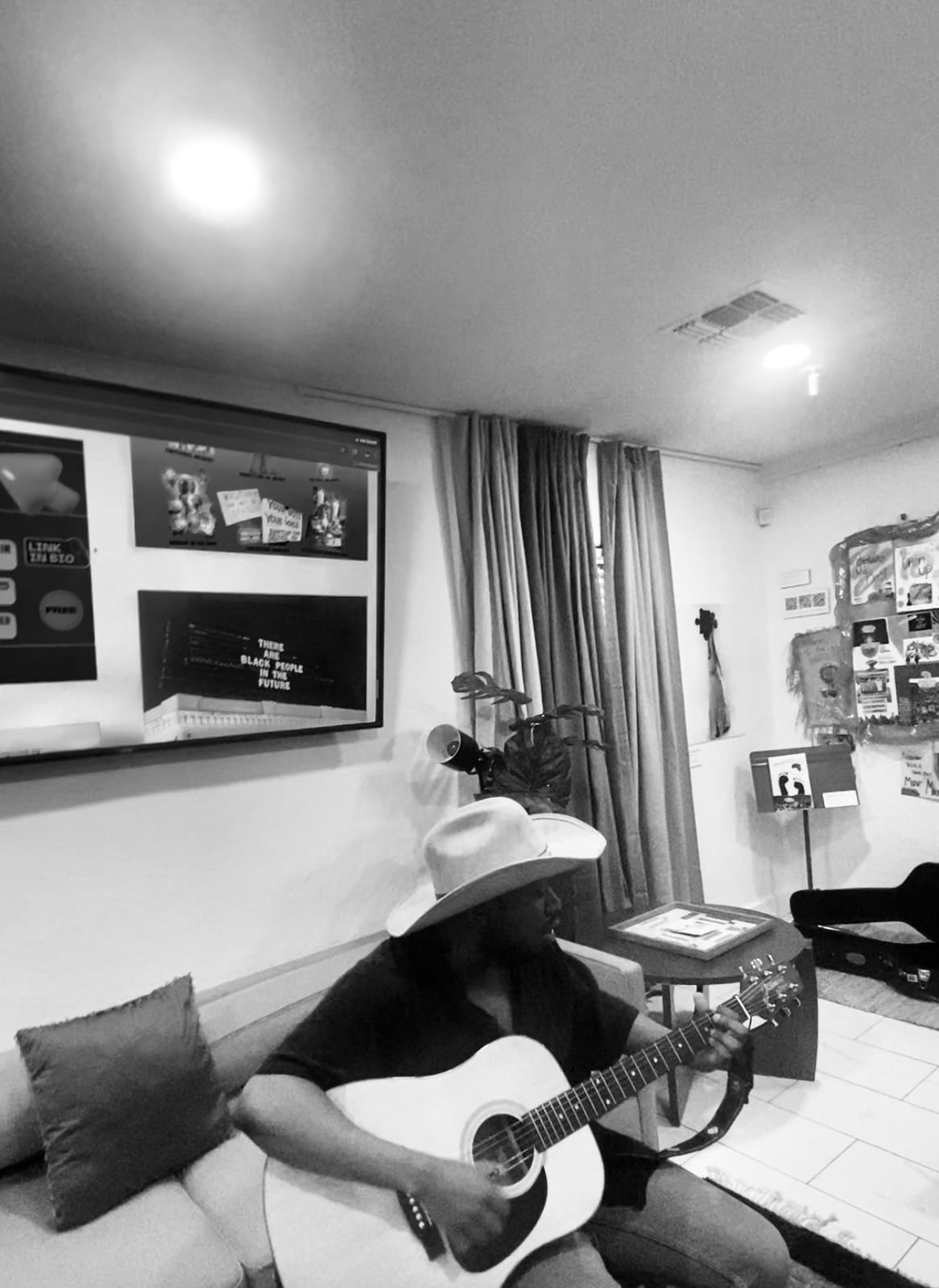
Courtesy of Chris Joseph, photo by Justin Town
LO: Switching gears here but, I've been seeing the news around Haitians with Temporary Protected Status being offered impossible ultimatums. I know it's on a state-by-state basis, but nationally, we've seen the president shift policy around Haitians and Haitian Americans. One of my favorite artists, Nina Simone, said, an artist's duty is to reflect the times, from what you've seen from conversations at Thyrd Space, and your personal experiences. What kind of times are we in right now? Also, what have you heard from people around you, how are they?
CJ: It's so wild because the people that I hear from, even my family - I have family who came here from Haiti - they lost their jobs […] it really amazes me how they can go through that and still show up to family dinners, and when you ask how they're doing, they are laughing about joys that they felt, you know what I mean? They are talking with my mom, they're still making food or doing things. I don't know if I have that level of strength that my cousins have. But it's fucked up. It's hard and we've had really difficult conversations about what to do next, how to support, you know, members in my family when they don't feel safe to maybe travel somewhere else where there's a bigger Haitian population.
CJ: Right now, we have just been waiting, waiting to see. If we're next, essentially, which is terrifying.
LO: The last question that I have here is, in all this chaos, there's still so much beauty in Haitian culture, specifically in Haitian art. How can we shift the conversation back to that?
CJ: It's educating ourselves. I think we are getting a little too comfortable not knowing shit. […] and really being diligent about who we're supporting. I think we should go out of our way to find a Haitian restaurant this week. There is Bebette's food truck. She has a food truck at Tabernacle of Grace Church on Sundays they make Haitian food. Go and support!
Before you go...
At LOOKOUT, we believe in the power of
community-supported journalism. You're at the heart of that community, and your support helps us deliver the
news and information the LGBTQ+ community needs to thrive.
A neighboring property owner to Barracks Bar Phoenix wants a judge to undo the state's approval of its liquor license, putting the future of a community leather space in continued limbo.
Two zine organizers in Colorado and Arizona talk on the politics of self-publishing across borders and how zines — especially in a world where zines are grounds for prosecution — are just as important today as they were decades ago.
LOOKOUT Publications (EIN: 92-3129757) is a federally recognized nonprofit news outlet.
All mailed inquiries can be sent to 221 E. Indianola Ave, Phoenix, AZ 85012.