POLITICS
The Man Behind the Anti-Trans Ballot Machine
Tim Mooney has spent years turning contentious political fights into ballot questions. Now, his operation is targeting transgender rights in the southwest.


Tucson police say the attack was motivated by anti-LGBTQ+ hate, but state law provides no standalone hate crime charge. Because the suspected shooter died, there will be no prosecution or sentencing enhancement in this case.

In the hours after two men were killed at Venture-N, Tucson officials repeatedly described the shooting as a hate crime investigation, citing Tucson Police reports that the suspect had a list of LGBTQ+ venues and appeared to intend further attacks before turning the gun on himself.
Tucson Mayor Regina Romero said on Monday after the shooting that the Tucson Police Department was “treating this entirely as a hate crime.” Influencers, community members and news outlets made similar statements online.
But there’s one rub: Arizona does not have a standalone hate crime statute, and the current law that exists to enhance sentencing for people convicted of a felony doesn’t fully protect the LGBTQ+ community, as a whole.
Tucson Police said there was evidence that the shooter, 44-year-old Ousman Ceesay, was motivated by hate against the LGBTQ+ community.
Outside of the list of other LGBTQ+ friendly spaces in the city found on his body, Tucson Police revealed through a press release on Tuesday evening that after a search of the suspect’s home, detectives found “evidence to include a note that further indicated he acted alone and that this shooting was a targeted attack motivated by hate toward the LGBTQIA+ community.”
The shooting killed 33-year-old Cameron Capara and 42-year-old Vincent Siqueiros. Ceesay later died at the hospital of self-inflicted gun wounds, according to police.
That means there will be no criminal trial against Ceesay and no criminal sentence, exposing a gap between how Arizona officials are describing the city’s investigation and what it can actually deliver on in future violent attacks against LGBTQ+ people.
Arizona allows a judge to consider certain bias-related conduct when imposing a sentence for an underlying felony. Under state law, a defendant’s sentence can be increased when the offense was motivated by factors including the victim’s race, color, religion, national origin, gender, sexual orientation or disability.
But that provision applies at sentencing after a person has been convicted of an underlying felony. It does not create a separate offense of committing a hate crime, as in other states.
In the Venture-N case, since Ceesay allegedly turned the gun on himself, there can be no conviction or sentencing hearing because the suspected shooter is dead.
That doesn’t mean investigators cannot determine whether the shooting was motivated by anti-LGBTQ+ bias: Police can investigate motive, document evidence, and provide information to the public, but that’s the extent.
Pima County Attorney Laura Conover referenced this in an online statement after the shooting went public: “Because all known suspects are deceased, there will likely be no prosecution to follow,” she said. “Nevertheless, we have full confidence that the Tucson Police Department will thoroughly investigate what appears to be a hate-fueled attack.”
Arizona’s approach also affects how bias-motivated crimes are tracked and prosecuted across the state. Law enforcement agencies’ reporting of hate crime data has historically been inconsistent, making it difficult to establish a complete picture of bias-motivated violence in Arizona.
The state’s sentencing law also has limitations in how it defines protected groups. Gender identity is not expressly listed alongside sexual orientation in the relevant sentencing-enhancement statute, leaving questions about how transgender and gender-nonconforming victims would be treated when bias is alleged to be a factor in a crime.
 Celina Jiménez (she/her)
Federal law generally prohibits people convicted of felony offenses from possessing firearms. But Arizona does not create a separate firearm prohibition based solely on a conviction for a bias-motivated misdemeanor. A person convicted of certain violent misdemeanor conduct motivated by bias may not necessarily lose access to firearms under state law.
U.S. Rep. Adelita Grijalva pointed to that intersection after the Venture-N shooting, saying that when “hate is combined with easy access to firearms, the consequences can be deadly,” and calling for legislative action.
For people who knew Capara and Siqueiros, though, they want to see justice — and are unsure how an investigation into hate-based violence will aid their community in the future.
By Tuesday evening, a memorial outside Venture-N had sprawled across the entrance with flowers, candles, pictures, and cards, while regulars and community members gathered to remember the two men.
Many of them spoke about wanting justice for future victims of identity-based violence and their families, who will eventually face what they’re living with. But without protections in place legally, it’s unclear if that day will ever come.
 Celina Jiménez (she/her)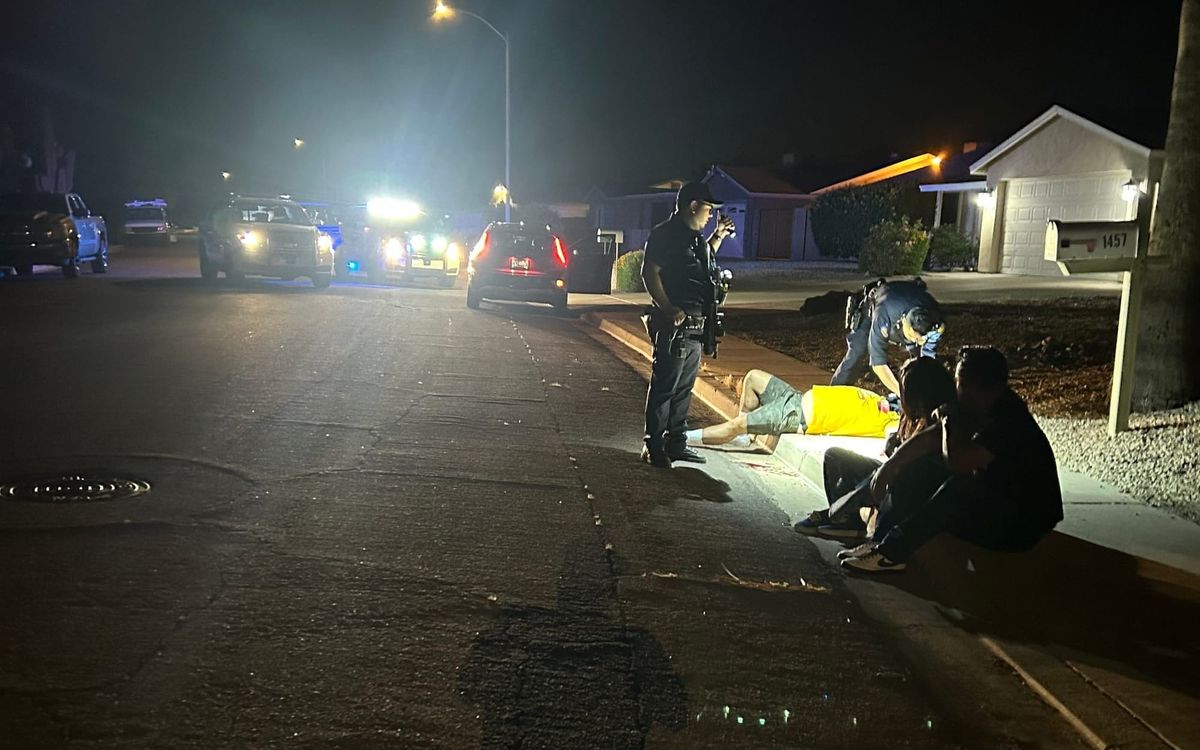
At LOOKOUT, we believe in the power of community-supported journalism. You're at the heart of that community, and your support helps us deliver the news and information the LGBTQ+ community needs to thrive.


After a raid, a seven-hour standoff and the felling of four cottonwoods, activists say they’re staying put. Overnight, agents moved on the last tree-sitter in Mexico.

Border Patrol agents arrested people protecting the tree Monday morning, ending a months-long protest.

The Tucson attack generated widespread coverage, but an analysis shows how quickly national attention faded as the community confronted its aftermath.

A whistleblower says the warden didn’t make a federally required disclosure. Now the company is turning the Arizona prison into an ICE jail.
LOOKOUT Publications (EIN: 92-3129757) is a federally recognized nonprofit news outlet.
All mailed inquiries can be sent to 221 E. Indianola Ave, Phoenix, AZ 85012.