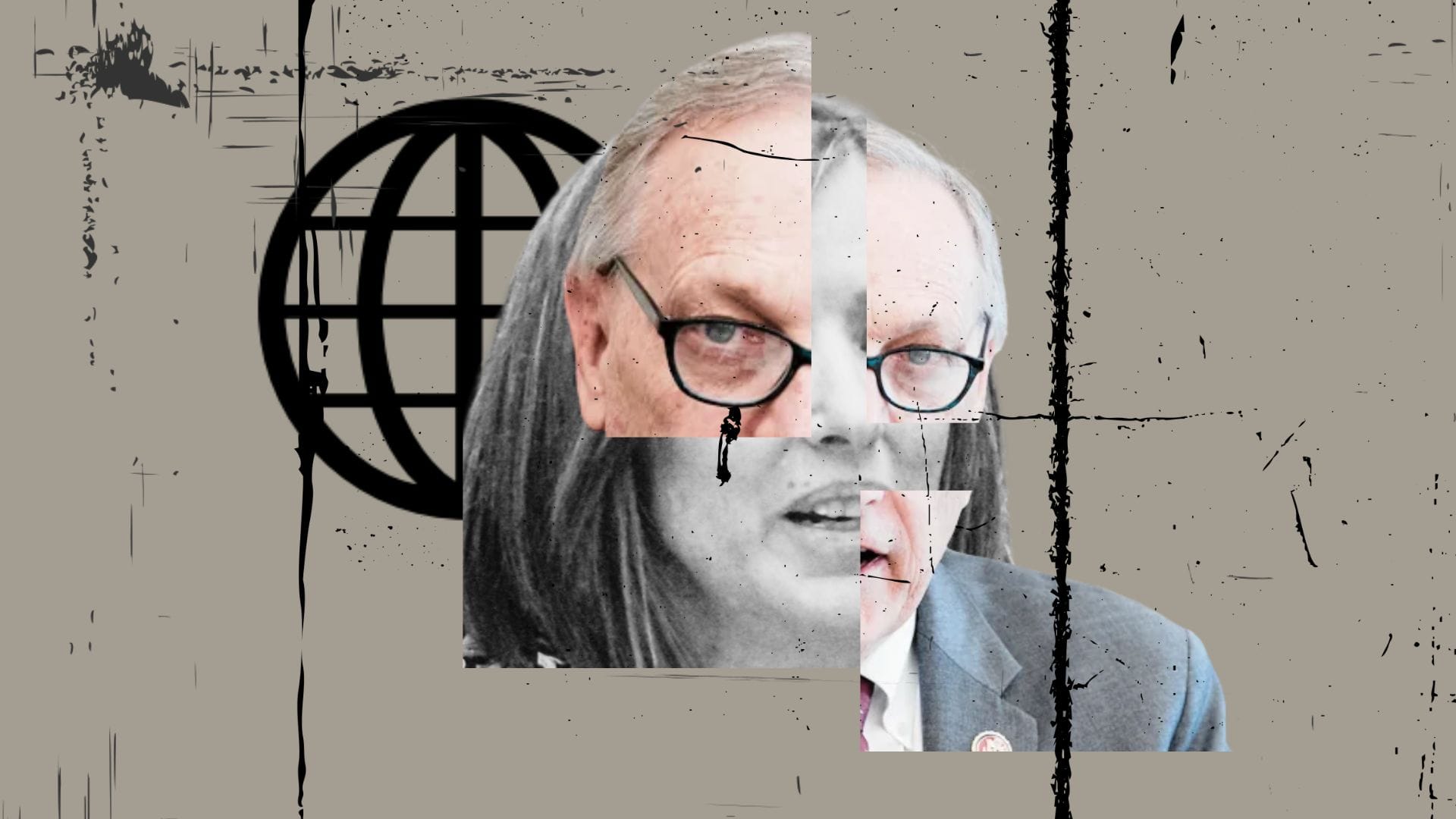
In a country that jails people for same-sex unions, Sharon Slater through her AZ-based nonprofit fought sex education and gender protections. Locals told us what it’s like to live under those policies.
From a 2002 endorsement to a 2026 campaign donation, the Republican nominee for governor and the Family Watch International founder have championed removing civil rights for LGBTQ+ people.
Biggs Has Ties to an Activist Who Fights Against Civil Rights in Africa
In a country that jails people for same-sex unions, Sharon Slater through her AZ-based nonprofit fought sex education and gender protections. Locals told us what it’s like to live under those policies.
This story was done in partnership with the Phoenix New Times
In 2017, Sharon Slater was in Lagos, Nigeria, joining activists and religious leaders in calling on lawmakers there to reject sexual education and a bill strengthening protections against gender discrimination.
It was a moment that Slater, the president of Gilbert-based Family Watch International (FWI), had spent almost two decades building toward, first back in the states, and now with religious and political leaders in Africa. The Southern Poverty Law Center designates FWI an anti-LGBTQ+ hate group.
At home, Slater has been a longtime ally of U.S. Rep. Andy Biggs, the Republican nominee for Arizona governor. She endorsed his first run for the state House in 2002, and she and her husband have given $3,000 to his gubernatorial campaign. And on his part, Biggs has sponsored and endorsed anti-LGBTQ+ bills that Slater’s organization has rallied behind.
Instead, she’s built alliances in Africa, where the lines between religion and policy are blurrier, and penalties for LGBTQ+ people being open are more punitive — even up to life imprisonment or death. Slater and FWI has consistently said to other news outlets that her organization does not assist in writing laws in other countries, and did not respond to multiple requests for comment.
A “family values” summit in Lagos
In March 2017, conservative activists, religious leaders and Nigerian government officials gathered at the Nigerian Institute of International Affairs in Lagos for a three-day conference on family values.
The event was an African regional gathering of the World Congress of Families, an international network of conservative groups that says it defends the “natural family,” a phrase used to describe heterosexual relationships. The conference was, in part, organized by FWI.
Nigeria had by then passed some of the continent’s most restrictive laws targeting LGBTQ+ people. In 2014, then-President Goodluck Jonathan signed the Same Sex Marriage (Prohibition) Act, 2013, which carries prison sentences of up to 14 years for entering into a same-sex marriage.
Sharon Slater’s anti-LGBTQ+ messages have landed in a country where religion, largely Christianity and Islam, plays a central role in public life.
The law also set a 10-year prison sentence for anyone who “registers, operates or participates in gay clubs, societies and organizations directly or indirectly,” or who publicly displays a same-sex romantic relationship. Human Rights Watch later released an 81-page report that documented how the law fueled arrests, extortion and violence against people suspected of being gay.
It’s against this backdrop that Slater and her organization has found success in pushing policies that curtail the civil rights of LGBTQ+ people in the country.
During the 2017 conference, Slater called comprehensive sexual education “one of the greatest assaults on the health and innocence of children,” she said. “Unlike traditional sex education, CSE promotes sexual promiscuity and presents high-risk sexual behaviours to children as if they are healthy and normal.”
The organization’s website has said that comprehensive sexual education also “Fails to teach that most gender-confused children resolve it by adulthood,” which there is no scientific backing for.
Continued push across Africa
After the conference, organizers issued a communique calling on Nigeria’s National Assembly and state legislatures to reject the Gender and Equal Opportunity Bill, which has stalled repeatedly since it was first introduced in 2010. The bill would grant equal rights for women in the country, aligning it with the United Nations Convention on the Elimination of All Forms of Discrimination Against Women. The group also urged officials to reject comprehensive sexual education in schools, along with international agreements they considered incompatible with African cultural values.
“I’m constantly worried if I will, one day, be bundled up, beaten and killed whenever I step out. The law, coupled with religion, motivates violence towards queer people.”
FWI’s work in Nigeria has primarily been focused on eliminating comprehensive sexual education. But CNN reported that Slater’s group has also been tied to helping draft a law in at least one African country — Uganda — that criminalized homosexuals, allowing for conversion therapy as “rehabilitation,” a practice FWI endorses. Slater and FWI consistently deny being involved in creating laws.
Slater’s message landed in a country where religion, largely Christianity and Islam, plays a central role in public life.
“They are not well, let them admit it,” he told The Guardian Nigeria. “They should go and get treatment.”
FWI has defended therapy for people with “unwanted same-sex attraction,” a practice also known as conversion therapy. The organization says it opposes coercive practices. Major medical organizations have rejected efforts to change sexual orientation as ineffective and potentially harmful.
Being “out” is a risk that can’t be taken
Understanding how these policies affect LGBTQ+ people is tenuous. Coming forward openly about being queer or even engaging in LGBTQ+ nightlife carries a substantial criminal risk. But LOOKOUT and Phoenix New Times were able to speak with Nigerians impacted by the policies that Slater and her organization have been on record advocating for. They were all granted various levels of anonymity for their safety.
Ayesha, a photojournalist who documents the lives of everyday Nigerians, said she had not personally encountered practices meant to change someone’s sexual orientation. But she has heard religious leaders use slurs and derogatory language about LGBTQ+ people in sermons.
“I don’t think I’ve heard, in Nigeria, any positive statement from religious leaders about queer people unfortunately,” Ayesha said.
For one Nigerian who presents as gender-nonconforming, they said simply leaving home is a risk.
“I’m constantly worried if I will, one day, be bundled up, beaten and killed whenever I step out,” they said. “The law, coupled with religion, motivates violence towards queer people.”
For Tony, a queer Nigerian and LGBTQ+ advocate, the push to change his sexuality came from his own church.
“They recommended conversion therapy which involved weekly physical prayer in church every Sunday and virtual prayer every day of the week,” Tony said. “They believed something was very wrong with me and I needed to be delivered.”
Through his advocacy, Tony said, he has since found supportive communities and health care through private organizations that serve queer Nigerians. But those resources are not available to everyone.
“In Nigeria, existing as a queer person and safety depends on how much you can afford to pay for your safety,” he said.
He also believes greater visibility has brought more hostility.
“The more visibility, the more discrimination because most individual actors perpetrating the violence used to believe we didn’t exist,” Tony said. “So, there has actually been more violence and pushback in recent years.”
Golden, a Nigerian writer who helps build alternative spaces for queer people, said they haven’t experienced violence, but they understand the fear of living in a nation that works consistently with groups to use the force of government to criminalize and ostracize LGBTQ+ people.
“My most significant experience of discrimination has not been violent, and very few LGBTQ persons in Nigeria can say that,” Golden said.
When straight friends talk about their relationships, Golden often feels unable to talk about their own.
“There is the fear that even if [my friend] would never attack me, he wouldn’t consider my problems as real as his,” they said. “This is the discrimination I live with … that my experiences sit outside the ones that are allowed to be talked about.”
Additional reporting by Morgan Fischer, Phoenix New Times
Before you go...
At LOOKOUT, we believe in the power of
community-supported journalism. You're at the heart of that community, and your support helps us deliver the
news and information the LGBTQ+ community needs to thrive.
LOOKOUT Publications (EIN: 92-3129757) is a federally recognized nonprofit news outlet.
All mailed inquiries can be sent to 221 E. Indianola Ave, Phoenix, AZ 85012.