CULTURE
A Magical Playground for the Wild, Weird, and Wonderful
Valley of the Moon has been delighting kids, punks, and queer folks for nearly 100 years—proof that whimsy isn’t just for storybooks.


As the Supreme Court weighs the future of state bans, a faith-based conference in Arizona shows how conversion therapy is being rebranded and revived.

Linda Seiler stood at the front of Radiant Church in Surprise on Nov. 8 and recounted what she described as a pivotal day in junior high, when she said she had three options: run away; have surgery and live as a boy; or stay with her family and live in despair.
The audience waited for the third option — the one they had come to hear about — her time in what is widely known as conversion therapy.
Seiler never called it that, though. Instead, she described it as a “transformation.”

The distinction may seem like semantics, but conversion therapy has resurfaced this year as more states enact bans on the discredited practice while the Supreme Court considers a case that could overturn those bans. In that case, Chiles v. Salar, private religious therapists in Colorado are arguing that a state law banning conversion therapy infringes on their right to speak openly about religion, which denounces LGBTQ+ people.
Opponents cite evidence from multiple medical organizations showing that efforts to change a person’s sexual orientation or gender identity are associated with higher rates of anxiety, depression and suicide. Professional associations, including the American Academy of Child and Adolescent Psychiatry and the American Psychological Association, consider conversion therapy professional misconduct. Many states have banned it for licensed therapists.
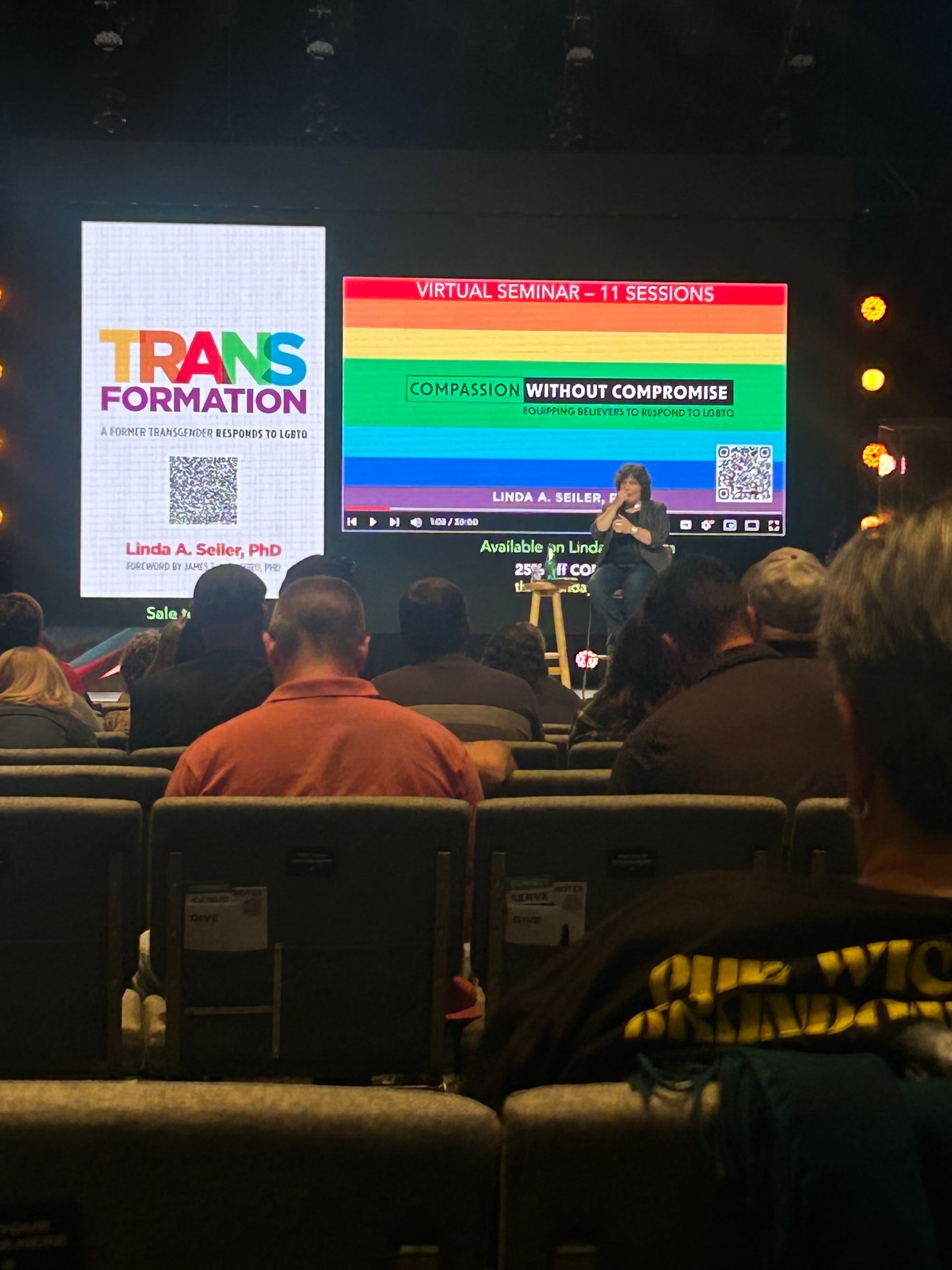
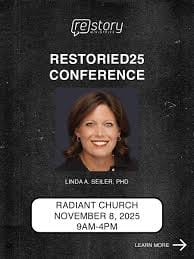
(Left) A photo taken from the Restory Conference on Nov. 8 with Linda Seiler speaking up front. (Right) An invite to the conference.
Yet practitioners such as Seiler have sought to avoid those laws by changing the language used to describe the practice, critics say.Some have turned to calling the practice “reparative therapy,” others couch it into “sexual addiction therapy.”
In Arizona, LOOKOUT reported last year that those definitional differences have allowed conversion therapy to be practiced by both licensed and unlicensed providers across Arizona, even with an executive order banning the state from providing recourses—such as licensing—to those medical providers.
Regardless of terminology, critics say the practices share a common goal: using religious or therapeutic frameworks to change a person’s sexual orientation or suppress gender dysphoria.
 Josephine Jaye McAuliffe (she/her)
Seiler, who earned a Ph.D. in intercultural studies from Assemblies of God Theological Seminary, brings credentials that supporters cite as academic credibility.
LOOKOUT sent a reporter to attend the ReStory Southwestern Conference to listen to Seiler’s seminar. We contacted Seiler multiple times seeking comment. She did not respond.
At her five-hour seminar during the “ReStory Southwestern Conference,” she made the case for conversion therapy — without using those words — through a quasi-academic framework and anecdotes from her own life, arguing that religion can erase LGBTQ+ identities.
The conference illustrated how much the practice has re-entered the country’s conversation after years of being castigated by medical professionals, especially as religious groups have made headways in public policy carveouts, specifically for discrimination against LGBTQ+ people.
As a minister for the Assemblies of God, the world’s largest Pentecostal denomination, Seiler views the world as a spiritual battlefield, but uses academic language to couch anti-LGBTQ+ ideas in her lessons.
For example, she referenced neuroplasticity—the brain’s ability to reorganize itself—to argue that LGBTQ+ identities are not “inborn and immutable,” though no scientific evidence supports this.
Medical experts and researchers dispute those claims.She asserted that “20% of this generation is adapting some form of an LGBTQ identity because it's cool.” A 2022 study from the American Academy of Pediatrics found no credible evidence for that claim.
While it’s true that more youth are identifying as queer,Gallup data released in February show the figure is less than 10% — up from 3.5% in 2012. Sociologists attribute the rise to shifting social attitudes toward LGBTQ+ people.
But Seiler attributed the increase to the debunked “rapid onset gender dysphoria” theory, a conservative concept that emerged from online critics of transgender civil rights.
Seiler also pulled from what was once considered fringe beliefs, linking transgender identities to “bestiality,” and referenced another debunked claim made by politicians — including ones in Arizona — that “elementary schools have been placing litter boxes in school bathrooms” and later suggesting that sex educators' shift from the “genderbread person” to the “gender unicorn” signals a move “towards bestiality.”
Seiler also cited a 2007 study by Wheaton College psychologists Mark Yarhouse and Stanton Jones, which claimed “religiously mediated sexual orientation change” was possible in 38% of participants. The study involved 98 participants, nearly a third of whom dropped out, and all were self-selected from an “ex-gay” ministry that later disbanded and renounced its philosophy.
Christian organizations like Baptist Press and Focus on the Family vaunted the study as an indication of conversion therapy’s feasibility, which “contradict the commonly expressed view that sexual orientation is not changeable, and that the attempt to change is highly likely to result in harm,” the researchers claimed.
But fact-checkers have highlighted significant flaws in the study’s execution.
 Josephine Jaye McAuliffe (she/her)
Relative to the 4,000 people Stanford Medicine studied last year to verify the link between conversion therapy and depression, Jones and Yarhouse’s sample population was only 98 people, with almost a third of the sample group dropping out of the study before its conclusion. The group was also self-selected from the study’s financial backer, an “ex-gay” ministry called “Exodus International,” which sought to support people with unwanted sexual attractions before disbanding and renouncing their philosophy in 2013.
Clinton Anderson, associate executive director for the American Psychological Association’s Office on Sexual Orientation and Gender Diversity in 2007, told Baptist News Global: “Even if you think it's an excellent study, why would they choose not to have it published in the peer-reviewed literature? That's where it belongs. Otherwise, I don't think I understand where they're coming from, as far as science and making a contribution to it.”
In addition to ministry work, Seiler serves as executive director of ReStory Ministries, a tax-exempt nonprofit endorsed by the Assemblies of God and its Arizona Ministry Network. The network advertised her seminar and promoted ReStory as a “ministry partner,” citing its mission to “create healing communities” by equipping churches and pastors with “resources and training that addresses LGBT.”
Most of those resources are spiritual counseling programs that critics say amount to conversion therapy.
“It’s like the boogeyman,” Seiler said at Radiant Church. “Nobody can define what it is.”
It’s true that “conversion therapy” as a practice hasn’t been defined by established medical groups like The American Psychiatric Association or the American Psychological Association— two of the preeminent medical organizations that establish standards for the industry.
But since homosexuality was removed from the Diagnostic and Statistical Manual of Mental Disorders in 1973 as a mental illness and gender dysphoria replaced gender identity disorder in 2013 as something that could be treated through medical and psychological care, both groups have opposed any attempts at conversion therapy, “refers to attempts to change a person's sexual orientation, gender identity, or related behaviors,” saying they are not based in evidence.
Nate Rhoton, CEO of Phoenix-based one•n•ten, which provides support for LGBTQ+ youth, called Seiler’s approach “selective science” and said people like her are “looking for any excuse to deny people their freedom and humanity.”
“The same logic has been used throughout history to justify discrimination against many communities,” he said. “Science was never the real motivation; control and prejudice were.”
While Seiler frames evidence-based gender-affirming care as a “demonic stronghold” that promotes “normalization of LGBTQ,” shifting issues from morality to civil rights, Rhoton said this rhetoric emboldens extremists and legitimizes “policies that deny youth access to care, censor curriculum, and criminalize families who affirm their children.”
 Josephine Jaye McAuliffe (she/her)
Joshua Kelison, founder of the Sexual Orientation and Gender Institute of Arizona, said Seiler’s lack of training in psychology or medicine means her teachings are “theoretical at best.”
He works with patients who have undergone religious conversion tactics and developed depression and post-traumatic stress.
“The research is clear that it actually does more harm than good,” Kelison said.
At LOOKOUT, we believe in the power of community-supported journalism. You're at the heart of that community, and your support helps us deliver the news and information the LGBTQ+ community needs to thrive.

LOOKOUT Publications (EIN: 92-3129757) is a federally recognized nonprofit news outlet.
All mailed inquiries can be sent to 221 E. Indianola Ave, Phoenix, AZ 85012.